Training · Guide · UK 2026
Do I need a CBCT reporting course to use a CBCT?
It's one of the first questions a dentist asks when a CBCT is on the cards: "Do I need to go on a course before I can use it?" The short answer is yes, some training is required. How much depends on what you'll be doing with the scanner. Here's how I understand the UK requirements. As always, check the detail with your Radiation Protection Adviser (RPA) and your indemnity provider.
The short answer
Under IR(ME)R 2017, everyone involved in a CBCT exposure must be adequately trained for their role. UK guidance describes two levels: Level 1 (core) training for anyone referring for or involved with CBCT, and Level 2 (further) training for those who justify exposures and clinically evaluate (report) the images. If you'll be reporting your own scans, you need the reporting-level training.
The IR(ME)R roles
The Ionising Radiation (Medical Exposure) Regulations 2017 set out roles (duty holders) for every medical exposure. In a dental practice one person often holds several of them:
- Referrer: asks for the scan, providing enough clinical information for it to be justified.
- Practitioner: justifies the exposure, deciding the benefit outweighs the risk for that patient.
- Operator: carries out any practical part of the exposure, from positioning the patient and choosing the protocol to processing the images and clinically evaluating them.
IR(ME)R requires the employer to make sure practitioners and operators are adequately trained, and to keep a record of that training. Every exposure must be justified and every image clinically evaluated, with the outcome recorded.
What the UK guidance says about CBCT training
The Guidance Notes for Dental Practitioners on the Safe Use of X-ray Equipment (2nd edition, 2020, Public Health England and FGDP(UK), now the College of General Dentistry) include updated recommendations on CBCT training for referrers, practitioners and operators (section 3.10). The two levels follow the approach developed in Europe through the SEDENTEXCT project and the European Academy of DentoMaxilloFacial Radiology:
- Level 1 (core): the principles: how CBCT works, radiation dose and protection, justification and selection criteria, anatomy and artefacts, and when to refer on. Appropriate for referrers and for operators who acquire scans.
- Level 2 (further): builds on Level 1 and covers justification and the interpretation and reporting of CBCT datasets. Appropriate for dentists who will justify and clinically evaluate scans.
Reporting: the whole volume, not just the area of interest
This is where many practices are caught out. The SEDENTEXCT basic principles state that CBCT images must undergo a thorough clinical evaluation of the entire image dataset. You're responsible for anything in the volume, not just the implant site or tooth you were looking at. For small dento-alveolar volumes, an adequately trained dentist can report. Larger volumes that include structures outside the jaws may need a dental and maxillofacial radiologist.
A good real example is the 360V case study the implant scan that found carotid artery calcifications, an incidental finding outside the area of interest.
So, do you need a reporting course?
- If you only refer patients for CBCT: Level 1 training is appropriate.
- If your nurse or radiographer acquires scans: they need operator training for the equipment and their role.
- If you justify and report your own scans: you need Level 2 reporting training, or you need to send scans to an appropriately trained reporter.
How 360V's courses fit
At 360 Visualise we offer two routes:
- The Level 1 online CBCT course is nine modules, done online at your own pace, with verifiable CPD and a certificate.
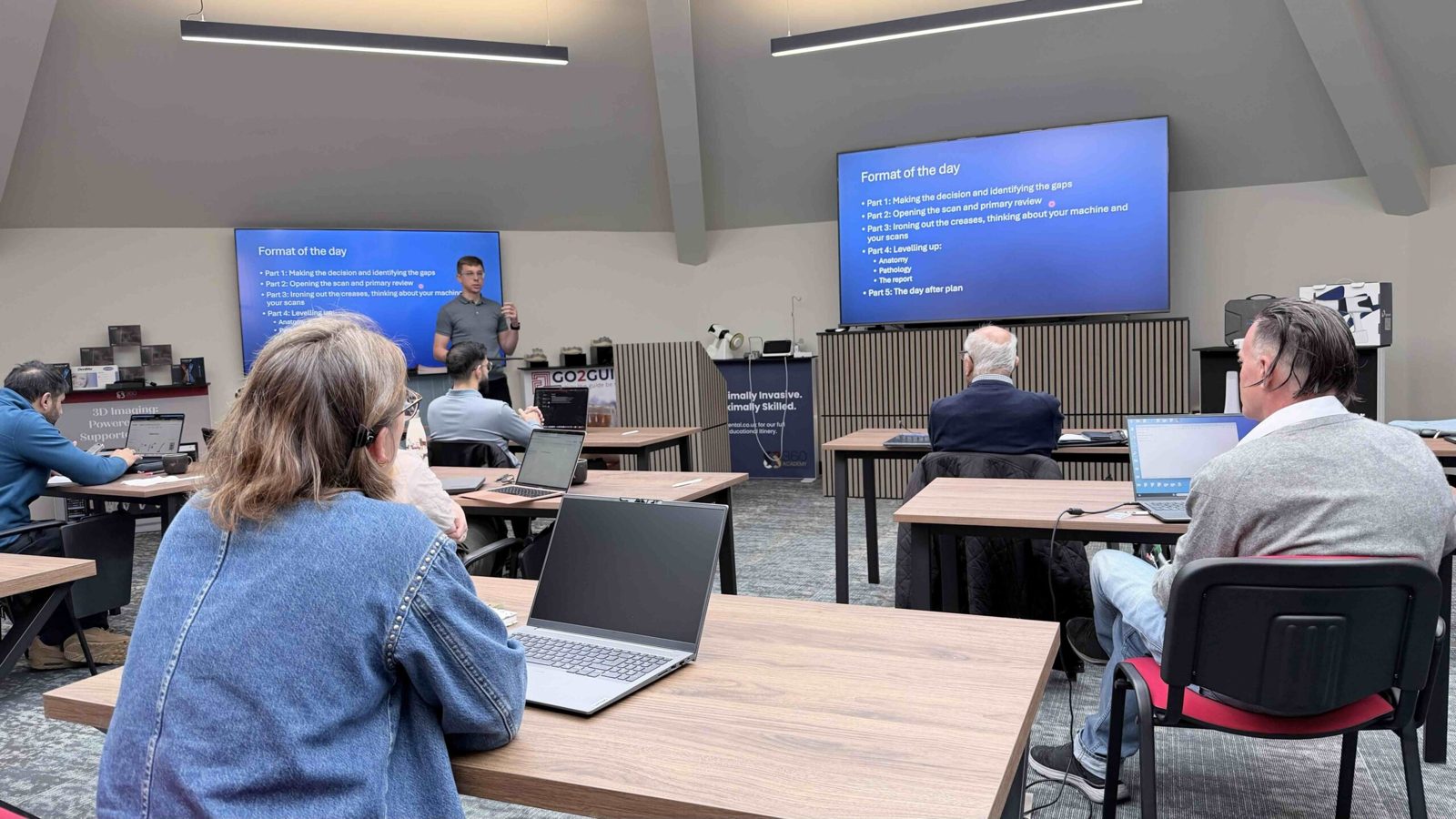
- The in-person CBCT Level 2 reporting course is a one-day course at Octagon House in West Yorkshire, led by Dr Ed Walker, Consultant Dental & Maxillofacial Radiologist. It covers reporting the whole volume, structured report writing and incidental findings. To join, you need a Level 1 CBCT course first, and either Level 1 qualifies: our online course or an in-person Level 1 course.

Also see why you should do Level 1 online, in your own time.
Keep the records
Keep certificates and CPD records for everyone in the practice, and list who is entitled to act as referrer, practitioner and operator in your IR(ME)R employer's procedures. Your RPA can help you set this up.
FAQ
Do I need training to use a CBCT in the UK?
Yes. IR(ME)R 2017 requires everyone involved in a CBCT exposure to be adequately trained for their role, and the 2020 Guidance Notes set out recommended training.
What is the difference between Level 1 and Level 2 CBCT training?
Level 1 (core) covers the principles: dose, justification, anatomy, artefacts. Level 2 (further) adds justification and interpretation and reporting of CBCT datasets.
Do I have to report the whole CBCT volume?
Yes. The whole dataset must be clinically evaluated, not just the area of interest. Larger volumes may need a specialist radiologist.
Can my dental nurse take CBCT scans?
Operators can be trained to acquire scans; they need training for that role and must be entitled under your IR(ME)R procedures.